
 Sport & Performance
 Luxury & Prestige
 Supercars
 Classic & Motorsport
 Porsche
 Ferrari
 Land Rover
 Lamborghini
 BMW
BMW
 Mercedes-Benz
.jpg?width=806&height=605&name=Dealership%20vs%20Car%20Finance%20Broker%20(3).jpg)
.jpg?width=1612&height=1210&name=Commercial%20Property%20Broker%20(14).jpg)
.svg) Agriculture
Agriculture
 Leisure & Hospitality
.svg) Construction
Construction
.svg) Manufacturing & Engineering
Manufacturing & Engineering
.svg) Commercial Vehicles
Commercial Vehicles
 Transport & Logistics
 Food & Beverage
 Utilities & Waste
.jpg?width=1209&height=908&name=Agricultural%20Finance%20Guide%202026%20Funding%20Options%20for%20UK%20Agribusinesses%20(3).jpg)
.jpg?width=806&height=605&name=Fix%20Auto%20Partnership%20Announcement%20(4).jpg)

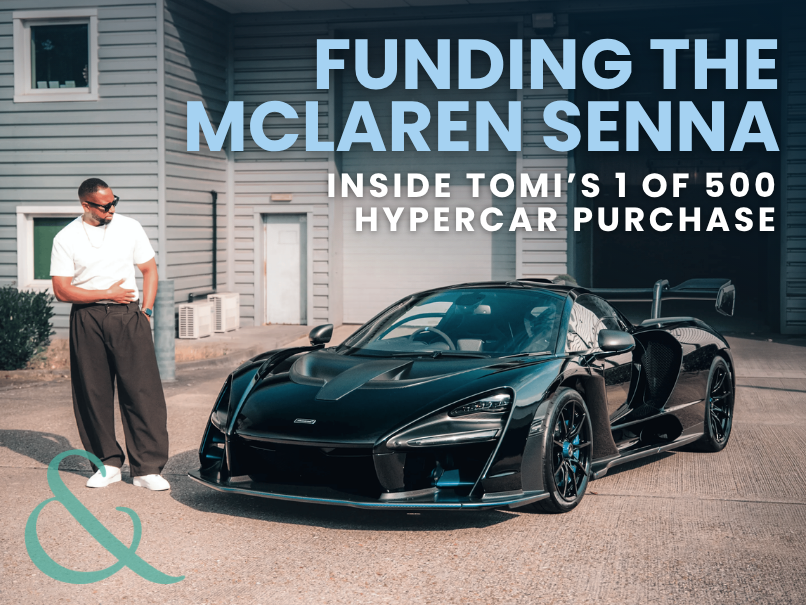
Only 500 road-going McLaren Sennas were built. Brand ambassador Tomi Adenlé, better known as Tomi Auto, now owns one of them.
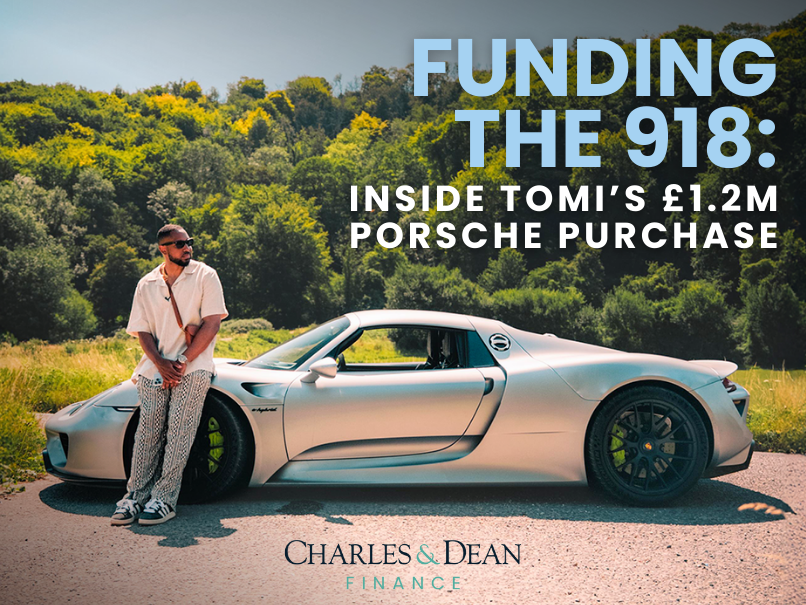
The Senna had been on his list before. When he was looking for his first hypercar in 2025, it made the shortlist before he ultimately chose a Porsche 918 Spyder, also funded through Charles & Dean. This time, he chose the Senna.

Why the McLaren Senna, And Why Now?
Tomi's shortlist started with six cars and eventually came down to three. A Lexus LFA and Porsche Carrera GT were the naturally aspirated options, while an Aston Martin Valhalla represented something much newer. The final three were the McLaren P1, Bugatti Veyron and Senna.
He considered a combination of factors, including potential future value, reliability and what each car would actually be like to drive. The Senna stood out for its production run of just 500 road cars, its focus on performance and its potential appeal as a future collectible.
The car was purchased through the Ventura Collection, a prestige supercar dealer in Milton Keynes. The Senna sits within McLaren's Ultimate Series, alongside the F1, P1, Speedtail, Elva and W1. It was designed as an uncompromising road car, with much of its engineering focused on performance rather than comfort.
What Makes Tomi’s Senna Different?
McLaren built 500 road-going Sennas between 2018 and 2019, with the allocation sold before deliveries began. Tomi's is number 54.
The track-only Senna GTR is a separate model, with 75 cars produced, so it is not included in the 500 road cars.
Tomi's Senna had covered just 590 miles when he collected it, putting it close to delivery mileage. That is one factor in its position within the market, but specification can be just as important. Colour combination, options and the amount of exposed carbon can all make a significant difference to the value of an individual car.
The Gorilla Glass door panels are one example. Of the 500 road cars, 100 were finished with exposed carbon. As a result, two Sennas from the same production run can be worth considerably different amounts.
What Is the McLaren Senna Like to Drive?
The numbers give a good indication of what McLaren was trying to achieve.
The Senna's 4.0-litre twin-turbocharged V8 produces 800 PS, or 789 bhp, and 800 Nm (590 lb-ft) of torque. It reaches 62 mph in 2.8 seconds and has a top speed of 208 mph. Its dry weight is 1,198 kg, making it the lightest McLaren road car since the F1 at launch.
The more interesting figures relate to its aerodynamics. McLaren quotes up to 800 kg of downforce at 155 mph, generated through its active aerodynamic system, including the front aero elements and large rear wing. Under heavy braking, the rear wing also acts as an airbrake.
The braking system is similarly focused, with 390 mm carbon-ceramic discs designed to cope with repeated high-performance driving.
Reviews of the Senna have tended to focus on its braking and cornering ability rather than simply its acceleration. Evo highlighted the car's cornering speeds and braking performance, while Motoring Research was similarly positive about its ability on the road.
The styling is subjective, but Tomi's description of the car as UFO-like is difficult to argue with.
Some of the unusual design features also have a practical purpose. The optional glass panels in the lower doors allow the driver to see the track surface alongside the car and help with positioning the car to see the apex of a corner.
Is the McLaren Senna a Modern Ferrari F40?
The comparison comes up regularly, and there are some obvious similarities.
Supercar Driver has looked at the parallels between the two cars, particularly their focus on performance, rear-wheel drive and twin-turbocharged engines. Both were designed around the driving experience, with comfort taking a back seat to performance.
There are also significant differences. Around 1,300 Ferrari F40s were produced, compared with 500 road-going Sennas, and the two cars come from very different periods of performance-car development.
The F40's market history is also a useful reminder that even highly desirable cars do not necessarily follow a straight line in value. Prices rose significantly between 2010 and 2015, reached a peak around 2022 and subsequently corrected.
That is worth bearing in mind when considering any hypercar primarily from an investment perspective.
What Happened to the Price Before Tomi Collected It?
In his video, Tomi says the car had increased in value by around £100,000 during the month between agreeing the purchase and collecting it.
He has not published the figures behind that transaction, so this should be treated as his experience with one car rather than a measure of the wider McLaren Senna market.
Price was an important consideration in Tomi's decision. McLaren has a reputation for significant depreciation across parts of its range, although the Ultimate Series has generally behaved differently. That distinction matters, because the performance of one McLaren model does not necessarily indicate what another will do.
The wider collector-car market has also been mixed. Knight Frank's Luxury Investment Index fell by 3.3% in 2024 and a further 0.4% in 2025, noting that scarcity alone does not guarantee future returns. Classic cars rose by 1.2% in 2024, making them one of the few categories to record positive growth.
At the top end, the 2026 Monterey auctions generated $718.3 million, compared with $432.8 million in 2025. However, much of this increase was concentrated among a small number of exceptional cars.
Senna prices have also moved considerably since the market softened in 2022 and 2023. At that point, the least expensive examples were available at around £650,000. Today, finding a Senna below £1 million is considerably more difficult.
We would currently place Tomi's car at around £1.15 million to £1.2 million, taking its mileage and specification into account. The original McLaren Senna price started at around £750,000 before options.
None of this guarantees where values go next. A car like the Senna has a relatively small pool of potential buyers, and prices can move in either direction.
Why Finance a Car You Could Buy Outright?
For a high-value car, financing is not necessarily about whether the buyer has enough cash to complete the purchase.
Money tied up in a car cannot be used elsewhere. For a business owner, that could mean capital that might otherwise be used for stock, hiring, expansion or another opportunity. Financing can allow a buyer to retain more liquidity while acquiring the vehicle.
Tomi made a similar point when discussing his Porsche 918. The decision to finance was not simply about being able to afford the car outright.
There is also a timing consideration with limited-production cars. A rare car can come to market with little warning, and a buyer who already has their finance arranged can move more quickly than someone starting the process from scratch.
Tomi discussed the finance with Charles & Dean before committing to the purchase.
How Do You Finance a Seven-Figure Car?
There is no single finance structure for a car at this level. The options depend on the vehicle, the buyer, the intended use and how they want to structure the repayments.
Our guide to financing a supercar covers the main options in more detail.
Lease Purchase
Lease Purchase is commonly used for high-value vehicles. The structure involves a deposit and monthly payments, with part of the balance deferred to a final balloon payment. This reduces the monthly payments compared with repaying the full balance over the term, while leaving the buyer with a larger amount to settle at the end.
The balloon can be settled at the end of the agreement or, subject to lender approval and the circumstances at the time, potentially refinanced. The important point is that it remains a commitment that needs to be considered when the finance is arranged. Unlike PCP, there is no option simply to hand the vehicle back at the end of the term.
Lease Purchase car finance can therefore provide a way of structuring the cost of a high-value vehicle without committing the entire balance to monthly repayments.
Read next: Lease Purchase Car Finance: UK Product Guide for 2026
Hire Purchase
Hire Purchase takes a more straightforward approach. A deposit is followed by fixed monthly payments, with the full balance repaid over the agreed term. Once the agreement has been completed, ownership transfers to the customer.
Because there is no deferred balloon, the monthly payments are higher than they would be under a comparable Lease Purchase agreement. The trade-off is that there is no large final payment to deal with at the end of the term.
Interest-Only and Refinance
Interest-only finance can be used where a buyer expects capital to become available at a defined point in the future, such as following a business sale or dividend. The capital balance remains due at the end of the agreed period, so the proposed repayment route needs to be considered from the outset.
Refinance and equity release work differently. They allow an owner to raise capital against a vehicle they already own, with the vehicle used as security for the finance. For collectors, this can provide a way to raise capital against an existing car without selling it.
For a car such as the Senna, valuation can be an important part of the process. There may be relatively few comparable sales, and the specification, mileage, condition and provenance can all affect how a lender assesses the vehicle.
Why Use a Broker for a High-Value Car Purchase?
High-value vehicle finance can involve lenders with very different approaches to valuation, income and finance structures.
Charles & Dean works with a panel of more than 100 lenders, including specialist funders that consider limited-production and high-value vehicles. Some of these lenders may not deal directly with customers or may not be available through every dealership.
Income can also be more complex at this level, with buyers potentially receiving dividends, retained profits or income from multiple businesses rather than a straightforward salary. Lenders apply different criteria to these income types, so available options vary between providers.
A limited-production hypercar can also have relatively few comparable sales, making specification, mileage, condition and provenance relevant to its valuation. Timing matters too: when a rare car comes to market, having the finance process underway can help a buyer work within the seller's completion timetable.
Charles & Dean is a credit broker, so our role is to compare finance options from our lender panel and assist with the application process. We are not financial advisers, and any finance agreement is subject to the lender's criteria and the individual's circumstances.
High Net Worth Car Finance: Regulated & Unregulated Agreements
At this level, car finance can be either regulated or unregulated depending on the borrower, purpose and structure of the agreement.
Certain business-purpose agreements can fall outside regulated consumer credit, while eligible high-net-worth individuals can also enter into certain agreements outside the usual consumer credit regime, subject to the relevant requirements.
Article 60H of the Financial Services and Markets Act 2000 (Regulated Activities) Order 2001 includes a high-net-worth exemption with criteria including net income of at least £150,000 or net assets of at least £500,000, alongside the relevant declaration requirements.
The regulatory status of an individual agreement depends on its circumstances. Unregulated finance does not provide the same consumer protections as regulated credit.
Tax treatment is separate and depends on the buyer's circumstances, so tax questions should be discussed with an accountant or tax adviser.
Considering Finance for a High-Value Vehicle?
The McLaren Senna is a limited-production car with just 500 road-going examples, and individual cars can vary considerably in value depending on mileage, specification and provenance.
Charles & Dean can compare finance options through its wide panel of lenders, including specialist funders that consider supercars and other high-value vehicles.
Explore our supercar finance options, read our guide to financing a supercar, or browse the Charles & Dean’s Knowledge Hub for more vehicle and business finance guides.
Speak to Charles & Dean on 01780 763836 or request a quote online.


Written by